Les'Tremblay
~
|
D'azur semé d'étoiles d'argent posées en cinq, deux, quatre, deux; en abîme, deux anneaux d'or entrelacés. Au chef, parties des armes du Perche et de l'Aunis, qui sont d'argent aux trois chevrons de gueules et au faucon d'or surmonté d'une couronne de vidame du même.
Of sown star azure of money posed into five, two, four, two; in abyss, two interlaced rings of gold. With the chief, parts of the weapons of the Pole. and Aunis, which are of money with three rafters of mouths and with the gold falcon surmounted by a crown of vidame of same.
|
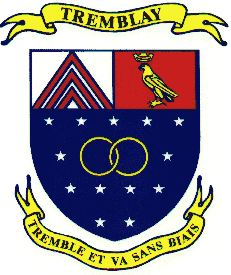
Tremble et va sans biais
Tremblay goes without skew, which is already a whole program of life.
“Or a loose translation”
:goes without wavering, or changing direction.
|
"The Tremblay name originates in France in the Normandy region. The earliest known Tremblay is Bernard de Tremblay who died in 1155. Next we find records in 1167 of a Guillaume de Tremblay who made a gift of a vast domain of land to the Trappist monastery. Then we skip to Gervais du Tremblay, a blacksmith, who built a forge on lands adjoining the Trappist monastery in Tourouvre, Perche, France. His descendants continued in this occupation in some line for several generations. One Tremblay of distinction is Father Joseph Tremblay, a man of great influence in the Richelieu administration in the early 1600's.. He was known as the confidant and lifelong associate of one of France's greatest statesman (Quarterly Review, April 1896). The forefather of Tremblay's in the New World was Pierre Tremblay. He was born at Saint-Malo de Randonnai about 1626. He came to Canada in August 1647. We are the largest family in North America that can trace their ancestry to one man."
"All members of the numerous Tremblay families of North America are descendants of Pierre Tremblay, born in 1626 in Randonnai, a small village of Perche, a former province of northern France. His parents, Philibert Tremblay and Jeanne Coignet were married October 3, 1623 in Saint-Firmin de Normandel, a nearby village. The same Philibert, a farmer from La Filonnière, died on November 17, 1642. The life of adventure attracted Pierre Tremblay. He was greatly influenced by the speeches of Noël Juchereau, a recruiting agent for New France, and signed a contract on April 9, 1647. With this contract, Pierre was hired by Juchereau to work for 36 months in New France. Pierre settled in the new world and then worked for farmers on the Côte de Beaupré, on the north shore of the Saint Laurence River.
In autumn of 1657, he met Ozanne Achon, a natife of Chambon, a diocese of La Rochelle. The couple signed a wedding contract before notary Aubert on September 19 and the religious ceremony was held on October 2, 1657 in Notre-Dame de Québec church. They had twelve children, ten of whom reached adulthood. Six daughters became the maternal ancestors of famous french canadian families: Roussin, Gagné, Savard, Perron, Peymard dit Laforest and Pelletier. Four sons, Pierre, Michel, Louis and Jacques married and became the founders of the four branches of the Tremblay family tree. All his life, Pierre Tremblay worked the land. On April 4, 1659, he received a land grant in L'Ange-Gardien. On December 1, 1678, Monseigneur de Laval employed Pierre to tend a farm in Baie Saint-Paul. Pierre also helped his sons obtain land in Petite Rivière Saint-François and Les Éboulements. The ancestral land in l'Ange-Gardien was given to Jacques, the third son on March 9, 1696 by Ozanne Achon, Pierre's widow. It recorded Ozanne was buried on December 24, 1707; at 75 years of age. Pierre, died twenty years previously. There is no record of his death or burial. Various archival documents suggest his death sometime between April 1687 and November 1689."
For more info read Les Tremblay by Patrick Chevassu,
published only in French to the best of my knowledge.
Also, a good source of info: Genealogy of Tremblay Family